Understanding Basic, Standard, and Enhanced DBS checks
Learn which Disclosure and Barring Service check may be appropriate, what the applicant needs to complete, and how results appear in Certn.
Overview
Disclosure and Barring Service checks help eligible employers assess an applicant’s criminal record history in England and Wales. Certn supports Basic, Standard, and Enhanced DBS checks. The appropriate level depends on the role and applicable law; employers are responsible for confirming that a role is eligible before ordering a Standard or Enhanced check.
Scotland uses Disclosure Scotland checks. Northern Ireland generally uses AccessNI checks. These are separate from DBS checks.
Choose the appropriate DBS check
| Check | What it may include | Typical use |
| Basic | Unspent convictions and conditional cautions | Roles where a criminal record check is appropriate but the position is not eligible for a higher-level check |
| Standard | Spent and unspent convictions, cautions, reprimands, and final warnings, subject to filtering rules | Eligible roles listed in legislation, such as certain positions of trust |
| Enhanced | Standard-level information plus relevant information held by local police; eligible checks may also include barred-list information | Eligible roles involving greater responsibility or regulated activity, including some work with children or vulnerable adults |
A Basic DBS check is the default for an address-based Criminal Record Report in England and Wales. Standard and Enhanced checks must be selected for an eligible role. Only one UK domestic criminal record check can be included in the same case.
What the applicant needs to do
To complete a DBS check, the applicant must complete the required steps through Certn, including:
- Verify their identity: Identity verification is required for all DBS checks.
- Provide their personal information: This includes their personal details and five years of address history, including their current address.
- Provide consent: The applicant must review and accept all required DBS consent statements.
- Provide supporting documentation: Provide identity document details or supporting documents when required.
Identity verification
Certn first attempts automated identity verification. If the applicant opts out of biometric verification or cannot be verified to the required confidence level, they will select “Click here…” as shown in the screenshot below.
When this occurs, the client may receive a task to complete manual identity verification in the Client Portal.
Manual verification for a Basic DBS check generally requires the verifier’s name. Standard and Enhanced checks require a document-based review, including the applicable DBS document route and whether the review occurred in person or by video.
If identity verification is incomplete, the DBS check remains blocked until manual verification is completed. Identity verification failure alone does not automatically cancel the DBS check.
To review the process for manual ID verification, please refer to details outlined here.
Consent and address requirements
If the applicant declines any required DBS consent, the check is cancelled and the ordering client is notified. A valid UK residence and postcode are also required for submission.
Once a check has been submitted, the information provided cannot be edited. If an applicant needs to correct or update required information after submission, the check may need to be reordered with the correct details.
How the process works
Watch our CertnCentric UK product demo: End-to-end screening process for a walkthrough of the platform and to familiarise yourself with your new dashboard.
- The client orders the appropriate DBS check.
- The applicant completes identity verification, address history, personal information, and consent.
- If automated identity verification is unsuccessful, the client completes the manual identity verification task.
- Certn submits the completed application to the DBS processing provider.
- Certn updates the report when the electronic result and certificate information are available.
Understanding results
Certn displays the electronic status and certificate details, such as the issue date and certificate number. Certn does not display conviction details. When a result requires review, the applicant must provide access to their DBS certificate or online certificate information, as applicable.
| Result in Certn | What it means |
| Clear | No relevant information was reported on the certificate. |
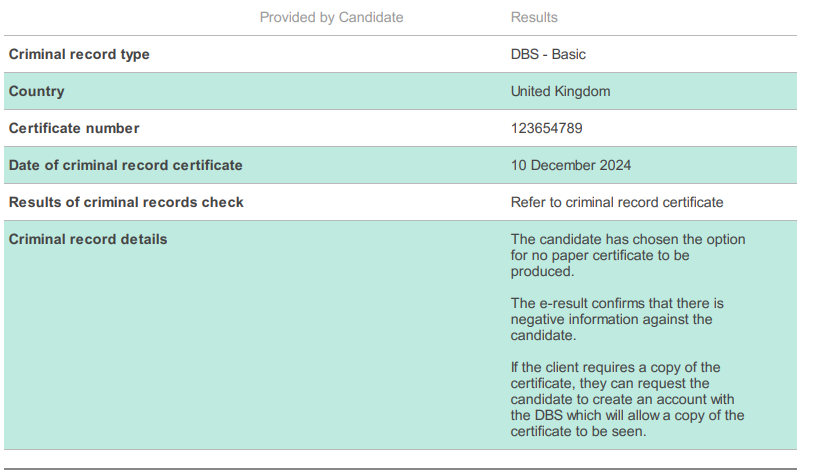
| Review or Results Found | For non-clear results, Centric stores the certificate status (date issued, certificate number) but the full certificate content is only viewable via the applicant's own DBS online account. Clients should expect to see "Refer to criminal record certificate," not a list of convictions. |
| Unable to Complete | The check could not be completed. This is a processing outcome and does not mean that a criminal record was found. |
| Unable to Fulfill | Unable to Fulfill means the check ended because of a permanent processing issue, such as the applicant withdrawing from the DBS process. |
A clear DBS result looks like this
A review or results found DBS looks like this
Fees
DBS checks may include a government fee and a Certn service fee. Identity verification services are billed separately.
Eligible volunteer Standard and Enhanced checks may have no government fee, but other service fees may still apply. Review your current pricing agreement or contact your Certn representative for current rates. Please review this page for more details.
Frequently asked questions
What is the difference between Basic, Standard, and Enhanced DBS checks?
A Basic check shows unspent convictions and conditional cautions. A Standard check can include spent and unspent convictions, cautions, reprimands, and final warnings, subject to filtering rules. An Enhanced check includes the Standard-level information plus relevant information held by local police and, when the role is eligible, barred-list information.
Does every UK criminal report use a Basic DBS check?
No. England and Wales default to a Basic DBS check for an address-based Criminal Record Report, but an eligible Standard or Enhanced check can be selected instead.
Scotland uses Disclosure Scotland. Checks for Northern Ireland may be routed to either a Basic DBS or AccessNI Basic check, depending on the service configuration.
Which UK criminal record check should I order?
The appropriate criminal record check is based on where your organisation is located, rather than where the candidate lives or works.
DBS checks are available to clients with offices located in England or Wales. If your organisation is based elsewhere in the UK, a Disclosure Scotland check should be ordered instead.
A candidate living or working in England or Wales does not, on its own, determine eligibility for a DBS check.
Why is identity verification required?
DBS applications require verified identity information. Certn attempts automated identity verification first. If the applicant cannot be verified automatically, the client must complete manual identity verification before the DBS application can be submitted.
Why is manual identity verification simpler for Basic than for Standard or Enhanced?
Basic checks use a lower identity-confidence requirement and generally require only the verifier’s name during manual review.
Standard and Enhanced checks use a higher confidence requirement and require a document-based review using the applicable DBS document route and review method.
What happens if the applicant refuses consent?
The DBS check is cancelled, and the ordering client receives an email notification.
Where does the applicant see their certificate?
Certn does not receive or have access to a copy of the applicant’s DBS certificate or the information contained within it. Instead, clients receive an overall result through the platform, such as Clear or Adverse.
During the DBS application process, the applicant can choose whether they would like a physical certificate to be produced:
- Digital results only: If the applicant chooses not to have a physical certificate produced, the detailed results are only available to the applicant through their digital access. The client will continue to see the applicable Clear or Adverse result through Certn.
- Printed certificate: If the applicant chooses to have a physical certificate produced, it can be mailed to their current home address or to another nominated address. If the client requires access to the physical certificate, the applicant should nominate the client’s head office address for delivery.
Can a DBS check be re-run if the applicant needs to correct their address?
The existing check cannot be updated once the applicant has submitted their details. A new case and check are required.
Why was the DBS check cancelled?
The most common reasons are that the applicant declined a required consent statement or did not provide a valid UK residence and postcode.
Why is the check waiting for action?
Identity verification may be incomplete. Check the Client Portal for a manual identity verification task. More details on this can be found here.
Does a DBS check cover all of the United Kingdom?
No. DBS checks apply to England and Wales. Scotland uses Disclosure Scotland, and Northern Ireland generally uses AccessNI.
Comments
0 comments
Article is closed for comments.